Build a Student Portfolio That Proves Your Skills — Even Without Work Experience
Nazik
Founder, Aspirev
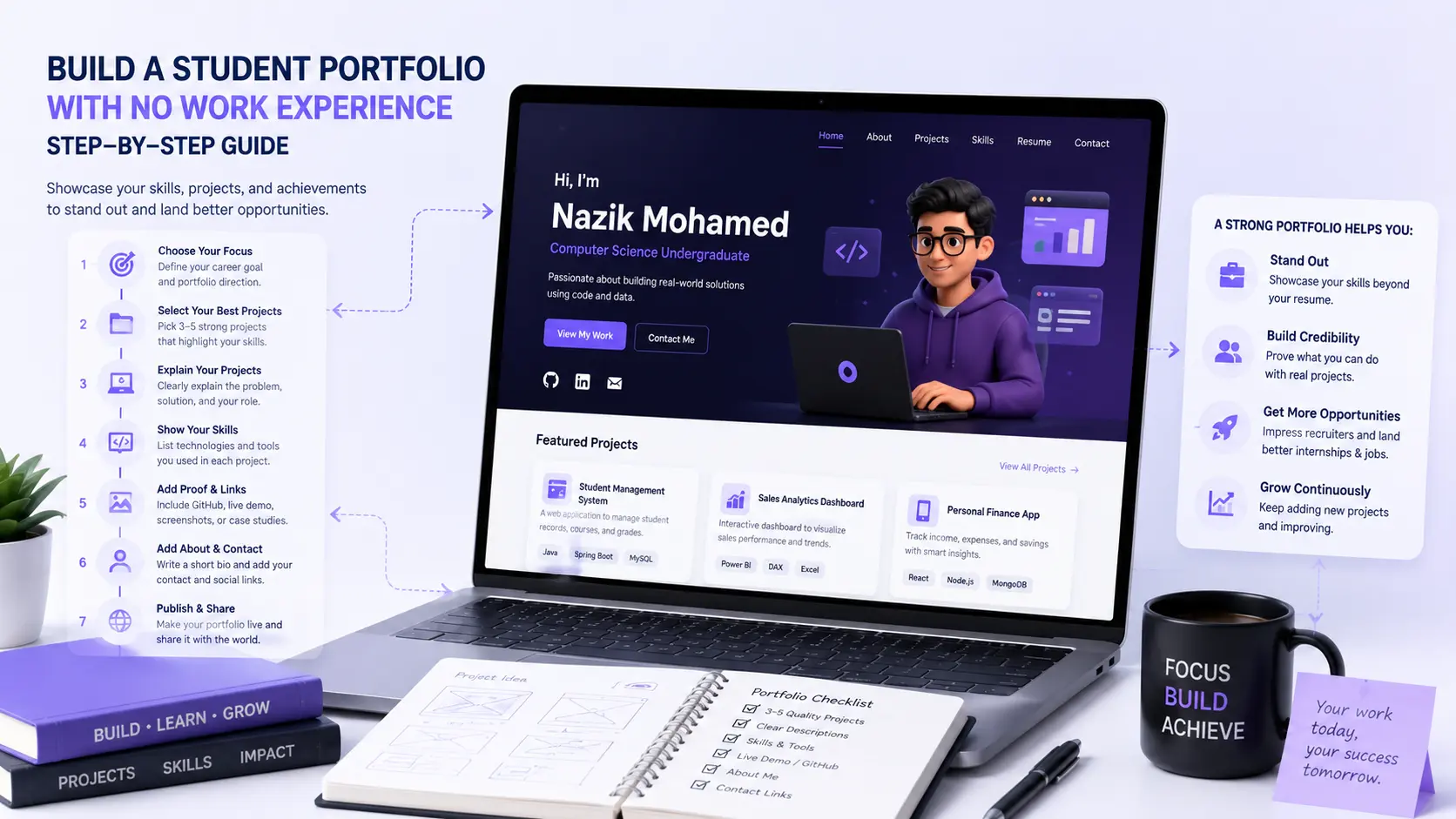
You don't need an internship, a full-time job, or years of professional experience to build a strong portfolio.
As a student, you already have evidence of what you can do. Your university projects, personal projects, research, assignments, certifications, competitions, volunteer work, and technical experiments can all become part of your professional story.
The challenge is not finding enough things to show. The challenge is knowing what is worth showing and how to present it professionally.
A good student portfolio should help someone quickly understand three things:
- What can you do?
- What have you built or worked on?
- What kind of opportunities are you looking for?
Here's how to turn your student experience into a portfolio that actually helps your career.
What Is a Student Portfolio?
A student portfolio is a collection of selected work and evidence that demonstrates your skills, interests, achievements, and development.
Unlike a resume, which summarizes your background, a portfolio can show the evidence behind your claims.
For example, your resume might say:
Python, SQL, Machine Learning
Your portfolio can show:
Customer Churn Prediction Project Built a machine learning model using Python and Scikit-learn to predict customer churn. Cleaned the dataset, performed exploratory data analysis, engineered features, and evaluated multiple models.
The second version gives someone something they can actually understand and evaluate. That is the real purpose of a portfolio: turning claims into evidence.
You Don't Need Work Experience to Start
One of the biggest mistakes students make is waiting until they get an internship before creating a portfolio. You don't need to wait.
University career guidance commonly recommends using academic projects, research, assignments, extracurricular activities, and other relevant work as portfolio material. If you have completed a university project, you already have something you can potentially showcase, such as:
- A software engineering project
- A machine learning model
- A data analysis
- A research project
- A dynamic website
- An open-source contribution
- A hackathon project
The important thing is not whether someone paid you to do it. The important thing is whether the work demonstrates something valuable.
Essential Rules for a Winning Student Portfolio
1. Start With Your Best 3 Projects
You don't need twenty projects. In fact, putting everything you've ever created into your portfolio can make it harder for someone to understand your strengths. Start with three strong projects that demonstrate different aspects of your ability.
For example, a Computer Science student could showcase:
- A technical project (e.g. Student Management System demonstrating Java, SQL, OOP)
- A data project (e.g. Sales Analytics Dashboard demonstrating Python, Pandas, Power BI)
- A personal project (e.g. Personal Finance App demonstrating React, APIs)
Three well-explained projects can communicate much more than a page filled with random project titles.
2. Turn Assignments Into Portfolio Evidence
A university assignment doesn't automatically become a great portfolio project. You need to present it differently. Instead of just writing "Java project for university," give the project context:
Library Management System Problem: Designed a system to help manage books, members, and borrowing records. My role: Designed the database structure and implemented the core application functionality. Technologies: Java, MySQL What I learned: Database relationships, object-oriented programming, and architecture. Evidence: GitHub repository / screenshots / demo.
Now the same assignment tells a much stronger story.
3. Use the Problem → Solution → Result Formula
A simple way to describe almost any project is:
- Problem: What were you trying to solve?
- Solution: What did you build or do?
- Result: What happened after you completed it?
This structure makes your projects easier to understand and gives recruiters context instead of just listing technologies.
4. Show Your Actual Contribution
If you worked in a group, don't claim that you built everything. Explain what you contributed.
Instead of: "Built an AI-powered healthcare application." Try: "Worked as part of a four-person team and developed the machine learning component for predicting patient risk. Prepared the dataset, trained the model, and evaluated its performance."
5. Add Proof Wherever Possible
Your portfolio becomes stronger when people can verify or explore your work. Depending on your field, this could include a GitHub repository, Live website, Demo, Figma prototype, Dashboard, or Research paper. Your portfolio evidence should match the type of career you are targeting.
6. Don't Put Everything in Your Portfolio
A portfolio is not your digital storage folder. You don't need to upload every assignment, every small experiment, or unfinished projects. Ask yourself: "Does this project help demonstrate the skills I want to be known for?" If the answer is no, leave it out.
7. Add a Short About Section
Your portfolio should quickly tell visitors who you are. You don't need a long biography. Try something like:
I'm a Computer Science undergraduate interested in Data Science and Machine Learning. I enjoy building data-driven applications, analyzing real-world problems, and turning ideas into practical solutions.
8. Keep Improving It While You Study
Don't wait until your final year. Your portfolio should grow with you.
- First year: University projects, small personal projects.
- Second year: Better technical projects, hackathons, open-source.
- Third year: Internships, larger projects, leadership.
- Final year: Your absolute best projects and professional direction.
By graduation, you won't be starting from zero. You'll already have a record of your development.
What If You Have No Good Projects Yet?
This is where you can create your own opportunities! Pick a real problem and build a small solution.
You don't need to pretend the project was commissioned by a company. Just label it honestly as a personal project, academic project, or practice project. The goal is to demonstrate initiative and ability.
Student Portfolio Checklist
Before sharing your portfolio, check:
- Is it clear what you study or specialize in?
- Does it show your best 3–5 projects?
- Does every project explain what you actually did?
- Are your technologies and skills clearly shown?
- Do important projects have evidence or links?
- Is your portfolio easy to navigate?
- Is your LinkedIn and GitHub included?
- Can someone contact you easily?
If you can answer yes to most of these, you're already much further ahead than a student who is waiting for their first job before creating any evidence of their skills!
Build Your Student Portfolio With Aspirev
Creating a professional portfolio doesn't have to start with designing a website from scratch.
With Aspirev's Portfolio Maker, students can build and publish a professional portfolio by adding their information, skills, projects, education, and achievements. You can create a portfolio that gives your work a professional home and share it with recruiters, employers, or anyone interested in your work.
Your experience may be limited. Your potential isn't.
Build Your Portfolio with Aspirev →
Final Thought
Don't ask yourself: "Do I have enough experience to build a portfolio?" Ask: "What evidence do I already have that shows what I can do?"
Your first portfolio doesn't need to be perfect. It just needs to exist. Start with three projects. Explain them clearly. Add proof. Keep improving. By the time your first major opportunity arrives, you'll already have something to show.