How to Build a Career Roadmap as a Student
Nazik
Founder, Aspirev
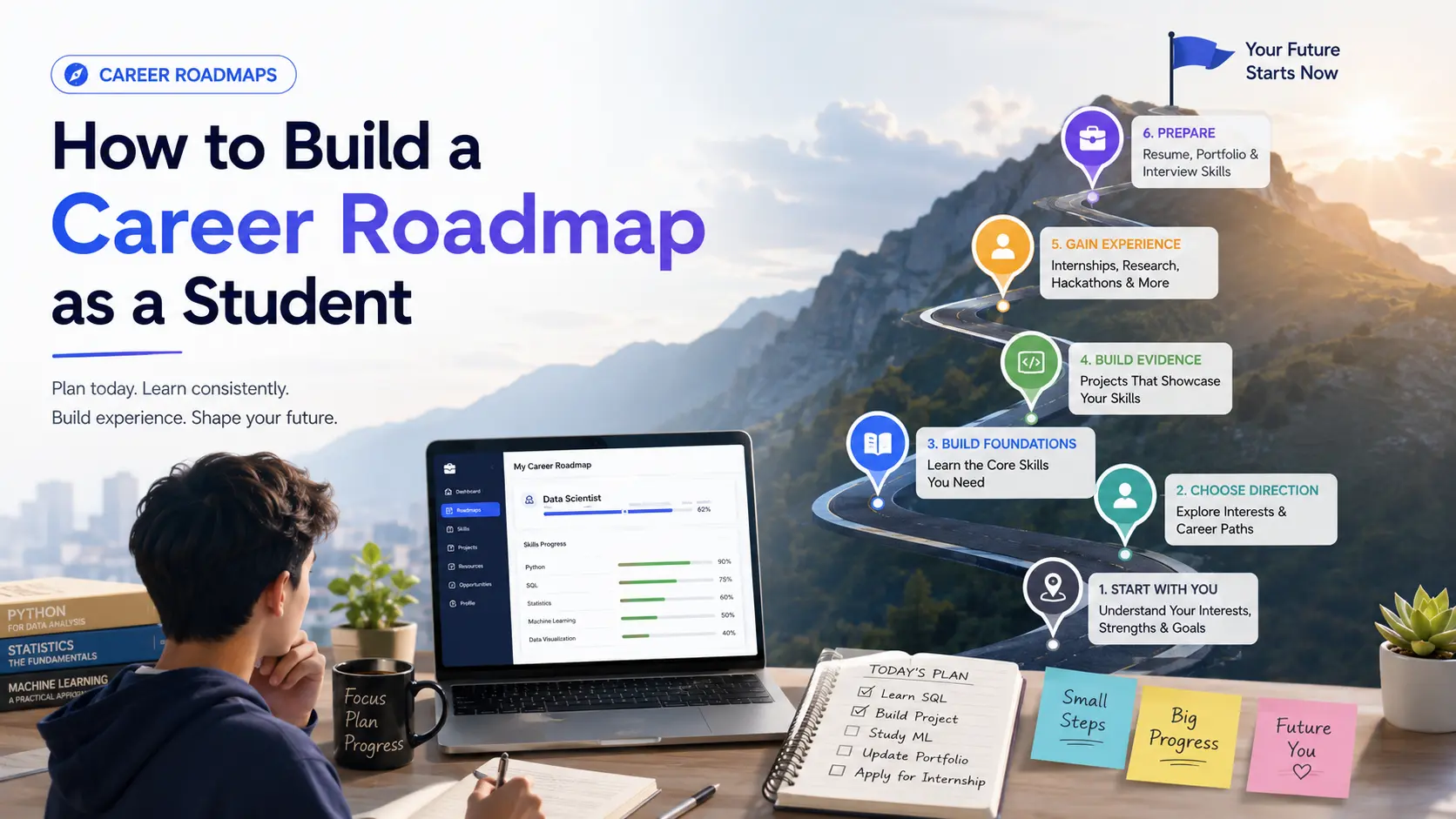
You don't need to know exactly what you'll be doing five or ten years from now. But having no direction at all can make university feel overwhelming.
You attend classes, complete assignments, learn new technologies, join activities, maybe build a few projects—and suddenly you're close to graduation wondering: "What should I actually do next?"
A career roadmap can help. A career roadmap isn't a rigid plan that tells you exactly what your future will look like. It's a practical way to connect your interests, skills, education, experience, and career goals so you know what to work on next.
Career centers commonly recommend starting career planning early and revisiting your direction as you gain new experiences. UC Berkeley, for example, encourages students to explore careers, develop skills, gain experience, build connections, and progressively prepare for internships and employment.
Here's how you can create one.
What Is a Career Roadmap?
A career roadmap is a plan that connects: Where you are now → Where you want to go → What you need to learn → What experience you need → What actions you should take next
For example, imagine you're a second-year Computer Science student interested in Data Science. Your roadmap might look like:
Now Computer Science student ↓ Build foundations Python + SQL + Statistics ↓ Build evidence Data analysis + ML projects ↓ Gain experience Internship / research / competitions ↓ Prepare Resume + portfolio + interview skills ↓ Target Data Analyst / Data Scientist roles
The roadmap doesn't guarantee that you'll follow exactly this path. You may discover that you enjoy software engineering more than data science. That's completely fine. A good roadmap should help you make better decisions, not lock you into one career.
Steps to Building Your Roadmap
1. Start With Yourself, Not a Job Title
Before searching for the "perfect career," understand what interests you. Think about:
- What subjects do you enjoy? (Programming, Mathematics, Design, Business, Research, Writing)
- What activities give you energy? (Projects, assignments, clubs, competitions)
- What are you naturally good at? (Solving problems, working with data, designing things)
You don't need perfect answers. You're simply looking for patterns.
2. Choose a Direction, Not a Lifetime Decision
One mistake students make is thinking: "I need to choose my career forever." Instead, choose a direction you want to explore next.
"I want to explore Data Science" is much more useful than "I must become a Data Scientist." Your direction gives you something to work toward while leaving room to change.
3. Identify the Skills You Need
Once you've chosen a direction, research what skills are actually required. Separate your skills into three groups:
- Already have: Skills you're comfortable using.
- Currently learning: Skills you're actively developing.
- Need to learn: Skills that are important for your target direction but you haven't developed yet.
4. Turn Skills Into Projects
Learning a skill is good. Using it to build something is better.
- Learning SQL → Analyze a real dataset.
- Learning React → Build a web application.
- Learning machine learning → Build and evaluate a prediction model.
Projects give you something tangible to discuss in interviews and showcase in your portfolio.
5. Gain Experience Before Graduation
You don't have to wait until your final year to gain relevant experience. Look for: Internships, Research projects, Hackathons, Open-source contributions, Freelance projects, and Volunteer work.
6. Create Short-Term Goals
Break a large goal into smaller targets. Instead of "Become a Data Scientist", try:
- Next 30 days: Learn Python data-analysis fundamentals.
- Next 60 days: Complete two data projects.
- Next 90 days: Build a portfolio and begin applying for relevant internships.
Evolving Your Career Path
Connect Your Roadmap to Your Resume
Your resume should evolve as your roadmap progresses. Your career development becomes a cycle: Learn → Build → Experience → Document → Improve → Repeat
Review Your Roadmap Regularly
Your roadmap should change. Don't treat changing direction as failure. Treat it as new information. A good roadmap should answer: "What should I do next based on what I know today?"
Use Real Job Descriptions to Build Your Roadmap
Look at actual jobs. Look for skills that repeatedly appear. If 10 Data Analyst internships mention SQL + Excel + Python + Power BI, you now have evidence about what skills may be worth prioritizing.
Build a Career Roadmap With Aspirev
Planning your career shouldn't mean keeping everything in separate notes, bookmarks, spreadsheets, and documents.
Aspirev's Career Roadmap helps students turn a career goal into a structured path. You can follow learning steps, discover curated free resources such as educational videos and articles, and track your progress as you develop the skills needed for your target direction.
Your roadmap can become the connection between: Career Goal → Skills → Learning → Projects → Experience → Opportunities
Your career development becomes one connected process instead of several separate tasks.
Explore Career Roadmaps with Aspirev →
Final Checklist
Before you finish your plan, ask yourself:
- Do I know which career areas I want to explore?
- Have I identified the skills I already have vs. the skills I need?
- Do I have projects that demonstrate my skills?
- Am I looking for opportunities to gain experience?
- Is my resume updated as I develop?
- Is my portfolio showing my strongest work?
- Am I reviewing and updating my roadmap regularly?
You don't need to know exactly where you'll be in five years. You just need enough clarity to decide what you should work on next.
Start building your path now.