How to Make Your Resume ATS-Friendly as a Student: A Complete Guide
Nazik
Founder, Aspirev
Applying for internships and graduate jobs can be frustrating. You may have a strong GPA, valuable projects, technical skills, certifications, and a good portfolio — yet still receive very few responses.
One reason can be how your resume is processed before a recruiter reads it. Many employers use an Applicant Tracking System (ATS) to collect, parse, organize, and filter applications.
Your resume therefore needs to work for two audiences:
- The ATS, which needs to understand your information correctly.
- The recruiter, who needs to understand your value quickly.
The good news is that you do not need a complicated resume to improve ATS compatibility. You need a resume that is clear, structured, relevant, and easy for software to parse. This guide explains exactly how students can create one.
What Is an ATS?
An Applicant Tracking System, commonly called an ATS, is software organizations use to help manage job applications. Depending on the employer and system, an ATS may process information such as:
- your name and contact details,
- education,
- work experience,
- skills,
- certifications,
- projects,
- keywords,
- and other application information.
The exact behavior varies between systems and employers, so no resume checker can honestly guarantee that a resume will receive a particular result from every ATS. The practical goal is to make your resume easy to parse and closely aligned with the job you're applying for.
Why ATS Compatibility Matters for Students
Students often have strong qualifications but less formal work experience. That means your resume needs to communicate your value efficiently.
For example, a student applying for a Data Science internship might have:
- Python
- SQL
- Pandas
- NumPy
- Scikit-learn
- Machine Learning projects
- Power BI
- university coursework
- certifications
If those qualifications are presented clearly and the resume is tailored to the job, a recruiter can understand the candidate's relevance much faster. An ATS-friendly resume helps make that information easier for automated systems to process.
For most students, a straightforward structure is the safest starting point. A typical structure is:
Contact Information
Name, Phone, Email, LinkedIn, GitHub, Portfolio
Professional Summary
A short description of your background, target role, and strongest skills.
Skills
Relevant technical and professional skills.
Education
Degree, University, Expected graduation, GPA, Relevant coursework
Experience
Internships, Part-time jobs, Freelance work, Research
Projects
Project name, Description, Technologies, Results, GitHub/demo link
Certifications
Relevant certifications and training.
You do not have to use every section. Use the sections that genuinely apply to you.
One of the biggest practical ATS risks is unnecessary formatting complexity. Be cautious with:
- large tables,
- text boxes,
- important information embedded inside graphics,
- overly complicated multi-column layouts,
- decorative icons replacing important text,
- and unusual visual structures.
A design may look excellent to a human but still create parsing problems.
Safer approach
Use:
- normal text,
- clear headings,
- consistent bullet points,
- readable spacing,
- standard dates,
- and obvious section boundaries.
Example
Instead of putting your skills inside a complicated table, use: Technical Skills Python · SQL · Docker · Git · Azure
The second structure is simpler for both humans and many parsers.
Section headings help both readers and automated systems understand the document. Prefer headings such as:
- Summary
- Professional Summary
- Experience
- Work Experience
- Education
- Skills
- Technical Skills
- Projects
- Certifications
Avoid making every heading creative. For example: Good > Technical Skills Less clear > My Toolkit
Similarly: Good > Work Experience Less clear > Where I've Worked
Creative headings can be interesting visually, but standard headings are usually safer when your primary goal is clarity.
This is one of the most important parts of ATS optimization. Suppose a job description says:
Python, SQL, Docker, AWS, ETL, data pipelines
Your resume should accurately reflect the skills you genuinely have that are relevant to the position. For example: Skills: Python, SQL, Docker, AWS, ETL, Data Pipelines
Do not add a technology you have never used simply because it appears in the job description. The goal is accurate alignment, not keyword stuffing.
There are two useful ways to think about keywords.
Exact relevance
Job: Python
Resume: Python
Clear match.
Contextual relevance
Job: Data pipelines
Resume: Built ETL pipelines using Python and SQL to process customer data.
The second example demonstrates the skill rather than simply listing it. That is more persuasive to a recruiter.
Compare these two examples.
Weak
Python, Machine Learning, SQL
Stronger
Built a machine learning pipeline using Python, Pandas, and Scikit-learn to predict customer churn.
The second example tells the recruiter: what you know + how you used it. This is especially important for students who may not have extensive professional experience. Your projects can demonstrate skills just as effectively as internships when presented clearly.
Students often underestimate their projects. A good project section can compensate for limited professional experience.
Instead of:
Student Management System Java project.
write:
Student Management System Developed a Java-based application for managing student records, implementing CRUD operations and relational database integration. (Java, MySQL)
Even better:
Student Management System Built a Java and MySQL application for managing student records and automated administrative workflows, reducing repetitive manual data entry during testing.
The important pattern is: What did you build? How did you build it? What was the result?
Avoid vague phrases such as: helped with, worked on, responsible for, involved in, assisted with.
Use stronger verbs when they accurately describe your contribution:
- Developed
- Built
- Designed
- Implemented
- Automated
- Analyzed
- Optimized
- Deployed
- Led
- Improved
Example
Weak: > Worked on a machine learning project. Better: > Developed and evaluated a machine learning model for customer churn prediction using Python and TensorFlow. Best: > Developed an ANN-based customer churn prediction model using TensorFlow and Keras, improving minority-class recall from 67% to 83% after applying SMOTE.
The last example is stronger because it provides technical context and measurable impact.
Numbers make achievements easier to understand. Examples:
- 10,000 records
- 83% recall
- 60% reduction
- $2.3M opportunity
- 13,000+ records
- 40% faster
- 100+ participants
But never invent metrics. If you did not measure something, don't create a number just to make the resume look impressive.
Use a consistent format throughout the resume. For example: April 2026 – Present and: January 2025 – March 2026
Avoid mixing: 04/26 with Jan 2025 – Present. Consistent dates make the resume easier to scan and interpret.
Your name, email, phone, LinkedIn, GitHub, and portfolio should be clearly available as text. For example: Mohamed Nazik Galle, Sri Lanka email@example.com linkedin.com/in/example github.com/example portfolio.example.com
Clickable links are useful, but the visible text should also be meaningful.
Avoid putting your:
- skills,
- contact information,
- job title,
- experience,
- education,
inside a graphic or screenshot. ATS systems need actual text they can process. A decorative banner is fine. Your qualifications should remain accessible as text.
You do not need to include everything you have ever done. A student resume should prioritize information related to the role.
For a Data Science internship, relevant examples include:
- Python
- SQL
- Machine Learning
- Statistics
- Data Analysis
- Projects
- Research
- relevant certifications
- relevant coursework
A long list of unrelated skills can make your profile less focused.
You don't necessarily need one resume for every application. Consider creating versions for different targets. For example:
Data Scientist
Emphasize: Python, SQL, Statistics, Machine Learning, Predictive Modeling, Projects
ML Engineer
Emphasize: Python, TensorFlow/PyTorch, APIs, Deployment, Docker, Cloud, MLOps
Data Analyst
Emphasize: SQL, Excel, Power BI, Python, Statistics, Data Visualization
Your career may have one core identity, but your resume should speak the language of the role you're applying for.
This distinction is important.
ATS Compatibility
Asks: > Can the system read my resume properly? It focuses on: structure, formatting, sections, parseability, dates, and document organization.
ATS Matching
Asks: > How closely does my resume match this particular job? It considers: skills, keywords, experience, job terminology, education, and other relevant signals.
A resume can be highly parseable but still be a poor match for a particular job. For example: ATS compatibility: 95% Job match: 62% There is nothing contradictory about those results.
Before submitting your resume, ask:
Structure
- Are all major sections clearly labeled?
- Is the text readable?
- Are important details in normal text?
Contact
- Email included?
- Phone included?
- LinkedIn/GitHub/Portfolio included when relevant?
Skills
- Are the skills relevant to the role?
- Are important required skills honestly represented?
Experience & Projects
- Are bullets specific?
- Are action verbs used?
- Are achievements quantified when possible?
- Is the technology stack clear?
Formatting
- Are dates consistent?
- Are headings clear?
- Are tables or complex layouts creating unnecessary risk?
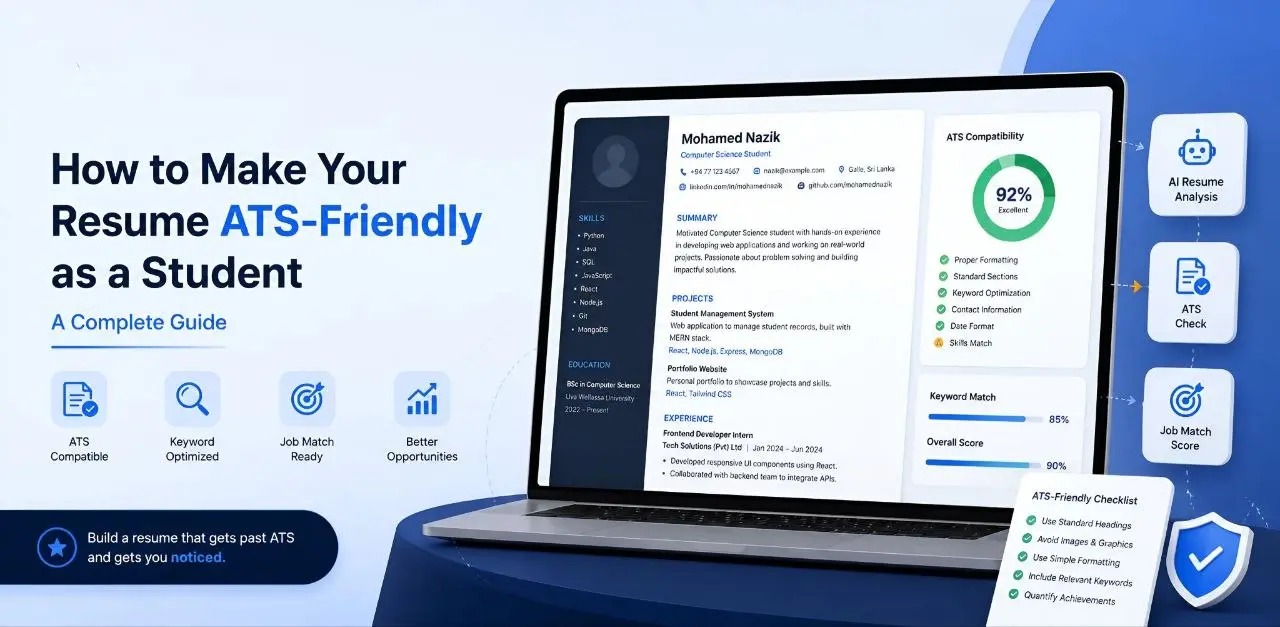
A Practical ATS-Friendly Student Resume Example
MOHAMED NAZIK
Galle, Sri Lanka | email@example.com | linkedin.com/in/example | github.com/example
PROFESSIONAL SUMMARY
Computer Science undergraduate specializing in Data Science and Machine Learning, with hands-on experience building predictive models, data analytics solutions, and end-to-end machine learning applications using Python, SQL, Scikit-learn, TensorFlow, and Power BI.
TECHNICAL SKILLS
Programming: Python, SQL, JavaScript Machine Learning: Scikit-learn, TensorFlow, Classification, Regression, Feature Engineering Data: Pandas, NumPy, Statistics, EDA Visualization: Power BI, Matplotlib
PROJECTS
Customer Churn Prediction Built an ANN-based machine learning model using TensorFlow and Keras to predict customer churn across 10,000 customer records. Applied SMOTE to address class imbalance and improved minority-class recall from 67% to 83%.
EDUCATION
BSc (Hons) in Computer Science & Technology Uva Wellassa University of Sri Lanka GPA: 3.52/4.00
CERTIFICATIONS
Machine Learning Specialization — Stanford University & DeepLearning.AI
Final ATS Checklist
Before submitting your resume:
- Make it readable.
- Use clear section headings.
- Match relevant keywords from the job description.
- Demonstrate skills through projects and experience.
- Quantify genuine achievements.
- Keep dates and formatting consistent.
- Avoid unnecessary tables, graphics, and complex layouts.
- Check the resume against the specific job you're applying for.
Try Your Resume with Aspirev
Reading an ATS guide is useful, but your resume is unique. Aspirev can analyze your resume, evaluate its overall quality, check ATS-style compatibility, compare it with a specific job description, identify missing skills and keywords, and provide actionable recommendations.
Analyze Your Resume with Aspirev →
The Key Takeaway
An ATS-friendly resume is not a resume filled with keywords. It is a resume that is: Easy to parse + relevant to the job + clear to recruiters + supported by evidence.
For students, the strongest evidence may come from projects, internships, coursework, certifications, research, leadership, and measurable results, not just formal employment.
Build for the ATS, but ultimately write for the human who decides whether you move forward.