How to Tailor Your Resume to a Job Description: A Step-by-Step Guide for Students
Nazik
Founder, Aspirev
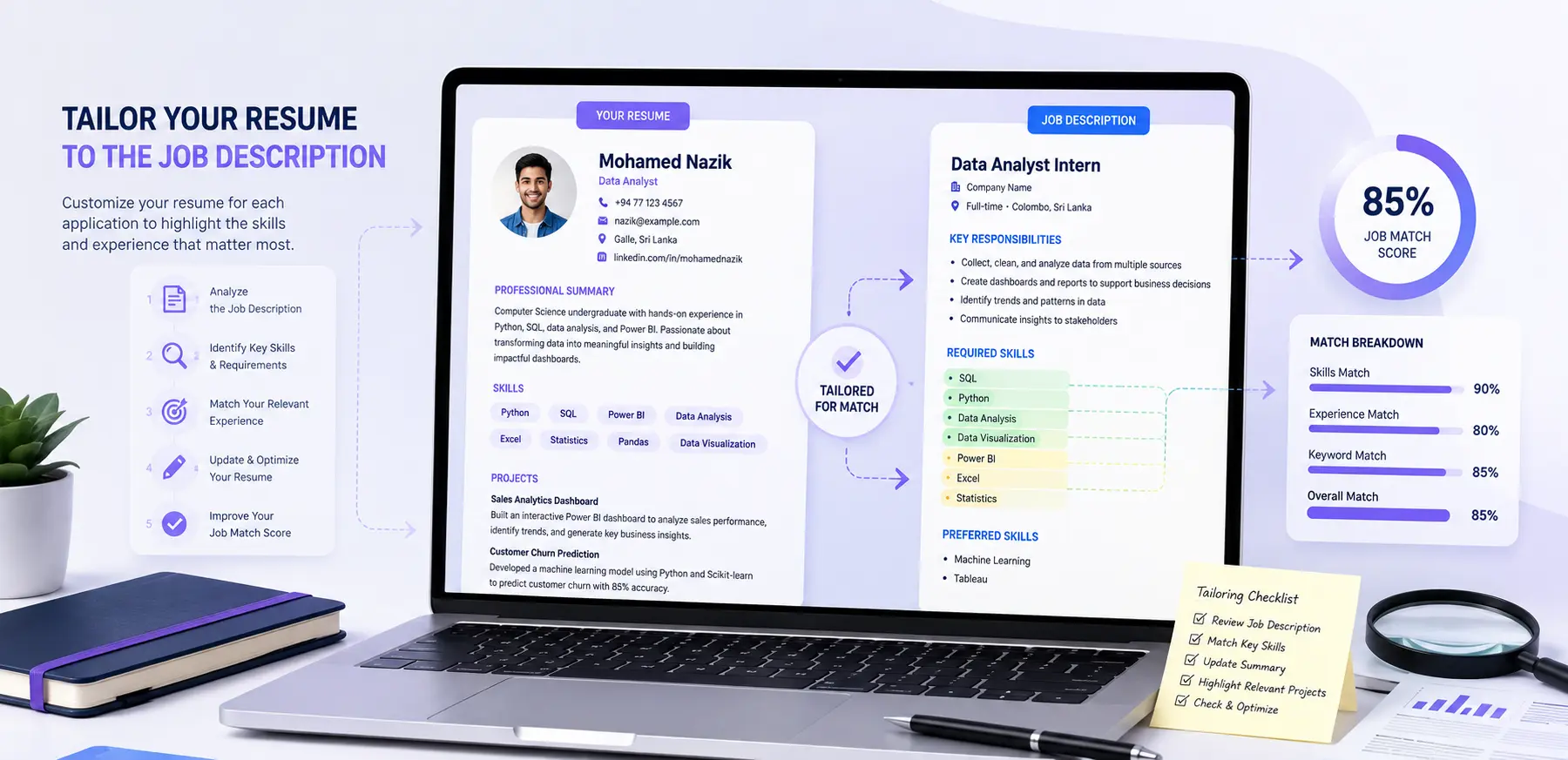
Table of Contents
- 01.What Does It Mean to Tailor a Resume?
- 02.Pre-Tailoring: The Base Resume
- 03.15-Minute Tailoring Process
- 04.Verification & Matching
- 05.A Complete Before and After Example
- 06.10-Minute Rapid Tailoring Strategy
- 07.Final Resume Tailoring Checklist Before Submitting
- 08.Use Aspirev to Check Your Job Match
- 09.The Key Takeaway
Applying for internships and entry-level jobs can be frustrating. You may have the right skills, projects, coursework, and certifications, but sending the same resume to every company can make your application look less relevant to the specific role.
The solution isn't to create a completely new resume for every application.
Instead, start with a strong base resume and tailor it to each job description by emphasizing the skills, experience, projects, and terminology that are genuinely relevant to that position.
In this guide, you'll learn how to tailor your resume step by step and improve its relevance for both recruiters and applicant tracking systems (ATS).
What Does It Mean to Tailor a Resume?
Tailoring your resume means adjusting your existing resume so it clearly reflects the requirements of a particular job.
You might change:
- Your professional summary
- The order of your skills
- Which projects you highlight
- Which experience bullets you emphasize
- The terminology you use
- The order of relevant information
You do not need to rewrite your entire resume every time.
The goal is simple: Make it easy for the employer to see why your existing experience is relevant to this particular job.
For students, this is especially useful because relevant evidence can come from projects, coursework, internships, research, certifications, and extracurricular activities—not only full-time employment.
Pre-Tailoring: The Base Resume
1. Start With a Strong Base Resume
Before tailoring your resume, create a master version containing your complete background.
Your base resume can include:
- Education
- Internships
- Projects
- Technical skills
- Certifications
- Research
- Leadership experience
- Volunteer experience
- Achievements
Think of this as your career information library. For each application, you select the information that is most relevant to that particular position.
Example:
Suppose you're a Computer Science student with these skills:
Python, Java, SQL, React, Docker, Power BI, Machine Learning
And these projects:
- Customer churn prediction
- E-commerce website
- Power BI sales dashboard
- Java inventory system
You wouldn't necessarily emphasize all four projects for every application. The target job determines what deserves the most attention.
15-Minute Tailoring Process
2. Read the Job Description Before Editing Your Resume
Don't immediately start changing your resume. Read the entire job description first. Look for five important things:
Job title What exact position are they hiring for? (For example: Data Analyst Intern)
Required skills Look for technologies and capabilities such as: SQL, Python, Excel, Power BI, Data analysis, Statistics.
Responsibilities What will you actually be doing? (For example: Analyze datasets, create dashboards, communicate insights, and support business decisions.)
Qualifications Look for: Degree requirements, Graduation requirements, Experience requirements, Certifications, Location requirements.
Repeated terminology Pay attention to concepts or skills that appear repeatedly. If the job description repeatedly mentions SQL, data analysis, dashboards, and business insights, those are likely important parts of the role.
3. Separate Required Skills From Preferred Skills
Not every keyword in a job description has the same importance. Create two groups:
Required: Python, SQL, Data analysis, Bachelor's degree Preferred: Power BI, AWS, Tableau, Machine Learning
If you genuinely have a required skill, make sure your resume communicates it clearly. If you don't have a skill, don't add it simply because you want a higher match score. Your resume should represent your actual experience.
4. Identify the Skills You Already Have
Now compare the job description with your own background.
Imagine the job asks for: Python, SQL, Power BI, data visualization, statistical analysis, machine learning.
Your actual skills are: Python, SQL, Power BI, Pandas, NumPy, Statistics.
Your matching skills are:
- Python ✓
- SQL ✓
- Power BI ✓
- Statistics ✓
You don't currently have:
- Machine Learning ✗
That's useful information. It tells you what to emphasize and what could become a future learning goal.
5. Use the Employer's Terminology When It Is Truthful
Suppose the job description says: Data visualization Your resume currently says: Created charts using Power BI.
You can make the connection clearer: Created interactive data visualizations and dashboards using Power BI.
You're not inventing experience. You're simply making the existing experience easier to understand. This is one of the most useful ways to improve the relevance of your resume while keeping it truthful.
6. Tailor Your Professional Summary
Your summary is one of the easiest sections to customize.
Generic:
Computer Science undergraduate with experience in software development, data analysis, and machine learning.
That's reasonable, but broad. Now imagine you're applying for a Data Analyst Intern position where the company wants SQL, Python, dashboards, and data analysis.
Targeted:
Computer Science undergraduate with hands-on experience in Python, SQL, data analysis, and Power BI, with experience developing analytical dashboards and working with real-world datasets.
The second version immediately communicates why you're relevant to the role.
7. Prioritize Relevant Skills
You don't always need to add more skills. Sometimes you simply need to prioritize the skills that are most relevant to the job.
General resume: React · Java · Docker · Python · SQL · Power BI · Machine Learning For a Data Analyst role: Python · SQL · Power BI · Data Analysis · Statistics · Pandas · NumPy For a Frontend Developer role: React · JavaScript · TypeScript · HTML · CSS · Git · Docker
Your actual skill set hasn't changed. You're simply making the most relevant skills easier to find.
8. Tailor Your Experience and Project Bullets
This is where resume tailoring becomes particularly powerful.
Imagine you're applying for a Machine Learning Intern position. Your original project description might say:
Built a customer churn prediction system using Python.
That's accurate, but it doesn't communicate much. A stronger version could be:
Developed a customer churn prediction model using Python and Scikit-learn, performing feature engineering and model evaluation on a customer dataset.
Now the bullet communicates: Python, Scikit-learn, Feature engineering, Model evaluation, and Machine learning. These details provide evidence for the skills you're claiming.
9. Use Projects as Evidence
Students often think they don't have enough experience because they haven't worked full-time. But projects can demonstrate real technical ability.
Imagine a job requires: Experience with REST APIs and Python.
Your project might involve:
Built a Python backend that exposes REST APIs for a machine learning prediction service.
That's relevant evidence. You don't need to have worked at a large company to demonstrate that you've used a technology. Projects, coursework, research, internships, and student organizations can all demonstrate relevant skills when they genuinely reflect your experience.
10. Don't Add Skills You Don't Have
This is one of the most important rules.
Suppose a job description says: Kubernetes, Docker, AWS, Terraform
And you only know Docker.
Don't change your resume to: Kubernetes · Docker · AWS · Terraform just because you want a better keyword match.
Instead, keep: Docker and recognize the other technologies as potential learning opportunities. A good resume-to-job match should reflect real alignment, not keyword stuffing.
11. Tailoring Doesn't Mean Changing Your Facts
Never change:
- Job titles
- Employment dates
- Education
- GPA
- Certifications
- Responsibilities
- Achievements
...just to make yourself look like a better candidate. Tailoring is about emphasis and clarity, not changing your history. Your resume should answer: Which parts of my real background are most relevant to this job?
Verification & Matching
12. Compare Your Resume Against the Job Description
After making your changes, perform another comparison. Create a simple checklist:
| Job requirement | On my resume? | Evidence? |
|---|---|---|
| Python | ✓ | Project |
| SQL | ✓ | Project |
| Power BI | ✓ | Dashboard |
| Data analysis | ✓ | Experience |
| AWS | ✗ | — |
| Statistics | ✓ | Coursework |
This gives you a much clearer picture than simply asking: "Does my resume look good?" Instead, ask: "Does my resume clearly demonstrate the requirements I actually meet?"
13. Understand ATS Compatibility vs. ATS Matching
These are two different things.
ATS Compatibility: Can the ATS read and understand my resume? (Formatting, Sections, Text structure, Dates, Document organization, Parseability)
ATS Matching: How closely does my resume match this particular job? (Skills, Keywords, Job terminology, Experience, Qualifications, Relevant projects)
A resume could be highly compatible with an ATS but still have a poor match for a particular job. For example: ATS Compatibility: 94% Job Match: 61%
Those results aren't contradictory. Your resume may be perfectly readable by the system but simply not contain enough relevant evidence for that particular position. If you want to learn more about making a resume ATS-friendly, read our ATS-Friendly Resume Guide.
A Complete Before and After Example
Imagine you're applying for a Data Analyst Intern role. The company asks for: SQL, Python, Power BI, Data analysis, Statistics, Dashboard development.
Generic Summary:
Computer Science student with experience in software development and machine learning.
Tailored Summary:
Computer Science undergraduate with hands-on experience in Python, SQL, data analysis, statistics, and Power BI, with experience developing interactive dashboards and analyzing real-world datasets.
The second version immediately communicates relevance. Now consider a project.
Before: Sales Dashboard
Created a dashboard using Power BI.
After: Sales Analytics Dashboard
Built an interactive Power BI dashboard to analyze sales performance, identify trends, and communicate key business insights using cleaned and transformed datasets.
The project hasn't magically become more impressive. You've simply made the relevant evidence clearer.
10-Minute Rapid Tailoring Strategy
You don't need to spend an hour rewriting your resume for every application. Try this process:
- Minutes 1–2: Read the job description carefully.
- Minutes 3–4: Identify Job title, required skills, preferred skills, important responsibilities, and repeated terminology.
- Minute 5: Compare those requirements with your actual skills and experience.
- Minute 6: Update your professional summary.
- Minute 7: Prioritize and reorder your relevant skills.
- Minutes 8–9: Strengthen your most relevant project or experience bullets using employer terminology.
- Minute 10: Check and perform a final resume-to-job comparison.
The exact time will vary depending on the job and how much editing is required, but the principle is simple: Make targeted changes instead of rewriting everything.
Final Resume Tailoring Checklist Before Submitting
- Do I know exactly what role I'm applying for?
- Does my summary reflect the target role?
- Are my most relevant skills easy to find?
- Are my most relevant projects or experiences prioritized?
- Do my bullets demonstrate the skills I claim?
- Did I use relevant terminology from the job description?
- Did I include measurable results where I genuinely have them?
- Did I compare the final resume against the job description?
Use Aspirev to Check Your Job Match
Manually comparing your resume with every job description can take time. Aspirev's ATS Matching feature helps you analyze how your resume aligns with a specific job description.
You can use the analysis to identify:
- Relevant skills
- Missing skills
- Areas of alignment
- Areas that need improvement
- Your overall job match
The goal isn't to manipulate a score. The goal is to understand: What does this job require, what do I already demonstrate, and what should I improve?
Analyze your resume with Aspirev →
The Key Takeaway
A strong resume isn't necessarily the same resume you send to every company. Your base resume contains your experience. Your tailored resume shows the employer which parts of that experience matter most for the specific role.
The process is simple: Read the job → identify requirements → find your matching evidence → tailor your summary → prioritize relevant skills → strengthen relevant bullets → check the match → apply.
As a student, your strongest evidence may come from projects, coursework, internships, research, certifications, and leadership, not just full-time employment.
Your goal isn't to make your resume look like the job description. Your goal is to make the connection between what the employer needs and what you can genuinely do impossible to miss.